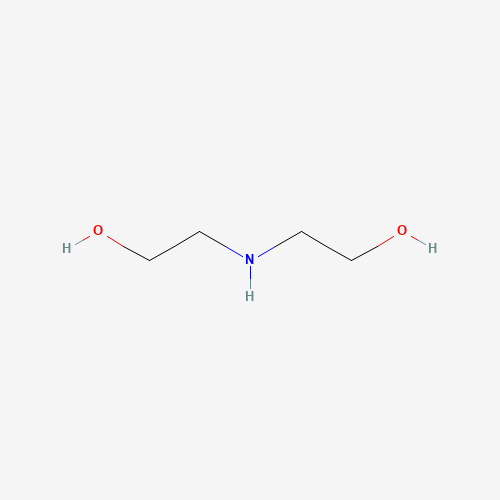
Diethanolamine
AKA “111-42-2, 2, 2'-Iminodiethanol, Diolamine, Iminodiethanol, Bis(2-hydroxyethyl)amine, 2-(2-Hydroxyethylamino)ethanol, Diethanolamin, Diethylolamine, 2'-Dihydroxydiethylamine”
Ingredient
Ingredient Facts
Diethanolamine
AKA: 111-42-2, 2, 2'-Iminodiethanol, Diolamine, Iminodiethanol, Bis(2-hydroxyethyl)amine, 2-(2-Hydroxyethylamino)ethanol, Diethylolamine, 2'-Dihydroxydiethylamine
Ingredient · Buffering · EWG: 10
Synthetic
Not Clean
Diethanolamine is used in a number of consumer products, such as shampoos, cosmetics, and pharmaceuticals. Limited information is available on the health effects of diethanolamine. Acute (short- term) inhalation exposure to diethanolamine in humans may result in irritation of the nose and throat, and dermal exposure may irritate the skin. No information is available on the chronic (long-term), reproductive, developmental, or carcinogenic effects of diethanolamine in humans. Animal studies have reported effects on the liver, kidney, blood, and central nervous system (CNS) from chronic oral exposure to diethanolamine. The National Toxicology Program (NTP) reported an increased incidence of liver and kidney tumors in mice from dermal exposure to diethanolamine. EPA has not classified diethanolamine for carcinogenicity.
Solubility greater than or equal to 100 mg/mL at 57 °F (NTP, 1992)
Formula
C4H11NO2
Mol. Weight
105.14
CAS #
111-42-2
Form
Liquid
State
Diethanolamine appears as oily colorless liquid or solid white crystals. Slight rotten fish or ammonia odor. Denser than water. (USCG, 1999)
See origin →
Functions
Buffering
Quells irritation
Traditional Use
Organic compound synthesized in the early 20th century from ethylene oxide and ammonia. Adopted widely in cosmetics in the 1950s as a pH buffer and emulsifying agent, particularly in creams and shampoos.
Skin Types
●all-skin-types
Best For
General
Pregnancy & Breastfeeding Safe
Yes
EWG
10
CIR
Safe as used
Pregnancy
Yes
Restricted By
CIR Safety Findings
Not a Sensitizer
medical-approval
all-shades-safe
Regulatory Agencies
🧂Conflict of interest.
Final Report on the Safety Assessment of Triethanolamine, Diethanolamine, and Monoethanolamine
Cosmetic Ingredient Review (CIR) Expert Panel
International Journal of Toxicology
Safety Assessment of Diethanolamine and Its Salts as Used in Cosmetics
Cosmetic Ingredient Review (CIR) Expert Panel
International Journal of Toxicology
Diethanolamine
Environmental Working Group (EWG)
EWG Skin Deep Cosmetics Database
Safety Assessment of Diethanolamine and Its Salts as Used...
Monice M Fiume, Bart Heldreth, Wilma F Bergfeld, Donald V Belsito, Ronald A Hill, Curtis D Klaassen + 6 more
International journal of toxicology, 2017
Safety Assessment of Diethanolamine and Its Salts as Used...
Monice M Fiume, Bart Heldreth, Wilma F Bergfeld, Donald V Belsito, Ronald A Hill, Curtis D Klaassen + 6 more
International journal of toxicology, 2017
Safety Assessment of Diethanolamine and Its Salts as Used...
Monice M Fiume, Bart Heldreth, Wilma F Bergfeld, Donald V Belsito, Ronald A Hill, Curtis D Klaassen + 6 more
International journal of toxicology, 2017
Formation and inhibition of N-nitrosodiethanolamine in cosmetics under pH, temperature, and fluorescent, ultraviolet, and visual light.
Lim DS, Lim SK, Kim MK, Kwon YC, Roh TH et al.
Journal of toxicology and environmental health. Part A, 2018
Allergic contact dermatitis caused by cocamide diethanolamine.
Mertens S, Gilissen L, Goossens A
Contact dermatitis, 2016
Verified Jun 2026 · 🧪 = conflict
Data: PubChem · CosIng · EWG · CIR