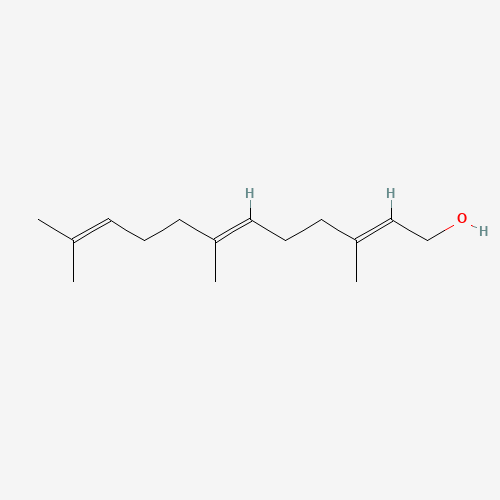






Farnesol
AKA “4602-84-0, 3, 7, 11-Trimethyl-2, 6, 10-dodecatrien-1-ol, Farnesyl alcohol, FCI 119a, 2, 10-Dodecatrien-1-ol, 11-trimethyl-, Trimethyl dodecatrienol, FEMA No. 2478, Nikkosome, 10-dodecatrienol”
Ingredient Facts
Farnesol
AKA: 4602-84-0, 3, 7, 11-Trimethyl-2, 6, 10-dodecatrien-1-ol, Farnesyl alcohol, FCI 119a, 2, 10-Dodecatrien-1-ol, 11-trimethyl-, Trimethyl dodecatrienol, FEMA No. 2478, Nikkosome, 10-dodecatrienol
Synthetic · Fragrance · EWG: 3
Synthetic
Fragrance
Not Clean
Farnesol is a signaling molecule that is derived from farnesyl diphosphate, an intermediate in the isoprenoid/cholesterol biosynthetic pathway. Farnesol is a 15 carbon isoprenoid alcohol is the corresponding dephosphorylated form of the isoprenoid farnesyl diphosphate. Farnesol has a potential role in controlling the degradation of 3-hydroxy-3-methylglutaryl coenzyme A (HMGCoA) reductase (EC 1.1.1.34, NADPH-hydroxymethylglutaryl-CoA reductase). The enzyme is stabilized under conditions of cellular sterol depletion (e.g. statin-treated cells) and rapidly degraded in sterol-loaded cells. In mammalian cells, this enhanced degradation is dependent on the presence of both a sterol and a non-sterol derived from the isoprenoid pathway; farnesol, the dephosphorylated form of farnesyl diphosphate, can function as the non-sterol component. Farnesol has been shown to activate the farnesoid receptor (FXR), a nuclear receptor that forms a functional heterodimer with RXR. Thus, dephosphorylation of
Solubility Soluble in three volumes of 70% alcohol
Formula
C15H26O
Mol. Weight
222.37
CAS #
4602-84-0
State
Farnesol is a colorless liquid with a delicate floral odor. (NTP, 1992)
See origin →
Functions
Fragrance
Added for scent. Can be natural or synthetic. Common irritant and allergen — one of the top reasons people react to products.
Controls Odor
Adds Fragrance
Neutralizes odor
Traditional Use
Modern synthetic ingredient designation. Specific traditional use cannot be determined without knowing which isomers are referenced; used in cosmetics as functional compounds with varying properties depending on chemical structure.
Skin Types
●all-skin-types
Best For
General
Squalane Facial Oil Home & Travel Duo
Indie Lee
Skin Renewal Mask (75mL)
Grown Alchemist
Mountain Glow Serum
Ursa Major
Golden Hour Body Serum
Ursa Major
Golden Hour Body Butter
Ursa Major
Forest Fix Spray Deodorant
Ursa Major
Botanic Buzz Body Lotion
Ursa Major
Rejuvenating Night Oil / Extra Healing
Marie Veronique
Protective Day Oil
Marie Veronique
Chebula Extreme Cream
True Botanicals
Revitalizing Body Oil
Tata Harper Skincare
Retinoic Nutrient Face Oil - 4ML
– Tata Harper Skincare
Tata Harper Skincare
Repairative Moisturizer - 10ML
– Tata Harper Skincare
Tata Harper Skincare
Repairative Moisturizer
Tata Harper Skincare
Crème Riche & Retinoic Nutrient Face Oil
Tata Harper Skincare
Crème Riche
Tata Harper Skincare
Bio-Shield Face Oil - 4ML
– Tata Harper Skincare
Tata Harper Skincare
Shaving Gel
Credo Beauty
Crème Riche - 7.5ML
Credo Beauty
Retinoic Nutrient Face Oil - 4ML
Credo Beauty
Repairative Moisturizer - 10ML
Credo Beauty
Golden Hour Body Butter
Credo Beauty
Moisture Lock Glossy Lip Balm
True Botanicals
Verified Jun 2026
Data: PubChem · CosIng · EWG · CIR