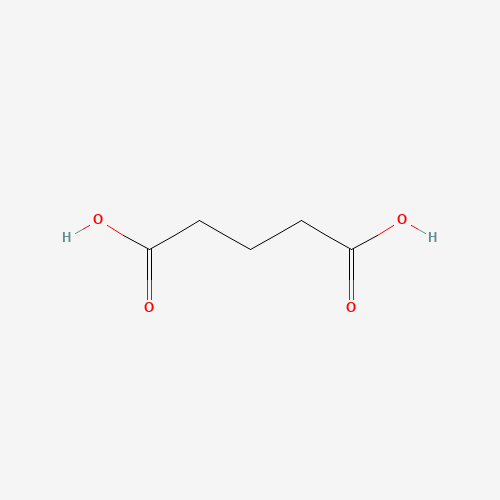
Glutaric Acid
AKA “Pentanedioic acid, 110-94-1, 1, 5-Pentanedioic acid, glutarate, 3-Propanedicarboxylic acid, Pentandioic acid, n-Pyrotartaric acid, DTXSID2021654, CHEBI:17859”
Acid
Ingredient Facts
Glutaric acid
AKA: Pentanedioic acid, 110-94-1, 1, 5-Pentanedioic acid, Glutarate, 3-Propanedicarboxylic acid, Pentandioic acid, N-Pyrotartaric acid, DTXSID2021654, CHEBI:17859
Acid · Buffering · EWG: 4
Synthetic
Acid
Not Clean
Glutaric acid is a simple five-carbon linear dicarboxylic acid. The accumulation of glutaric acid ranging from slightly or intermittently elevated urinary glutaric acid to gross organic aciduria occurs in Glutaric aciduria. Glutaric aciduria type 1 is an autosomal-recessive disorder resulting from a deficiency of mitochondrial glutaryl-CoA dehydrogenase (EC 1.3.99.7, GCDH) which is involved in the metabolism of lysine, hydroxylysine, and tryptophan. Glutaric aciduria type I lead to nonspecific developmental delay, hypotonia, and macrocephaly with cerebral atrophy of prenatal onset. Treatment is mainly based on restriction of lysine intake, supplementation of carnitine, and an intensification of therapy during intercurrent illnesses. The major principle of dietary treatment is to reduce the production of glutaric acid and 3-hydroxyglutaric acid by restriction of natural protein in general and of lysine in particular. (A3441, A3442).
Solubility greater than or equal to 100 mg/mL at 70 °F (NTP, 1992)
Formula
C5H8O4
Mol. Weight
132.11
CAS #
110-94-1
Form
Liquid
State
Glutaric acid appears as colorless crystals or white solid. (NTP, 1992)
See origin →
Functions
Buffering
Stabilizes pH
Anti-Aging Benefits
Antioxidant Protection
Reduces Inflammation
Traditional Use
A synthetic organic acid developed for industrial purposes in the 20th century. It was later incorporated into cosmetics as a pH buffer and preservative booster with no traditional use history.
Skin Types
●all-skin-types
Best For
General
Pregnancy & Breastfeeding Safe
Yes
RIFM fragrance ingredient safety assessment, pentanedioic acid, 1,5-dimethyl ester, CAS Registry Number 1119-40-0.
Api AM, Belsito D, Botelho D, Browne D, Bruze M et al.
Food and chemical toxicology : an international journal published for the British Industrial Biological Research Association, 2018
Diisobutyl Glutarate
European Commission
EU Cosmetic Ingredient Database (CosIng)
Diisostearyl Glutarate
European Commission
EU Cosmetic Ingredient Database (CosIng)
Dimethyl Glutarate
European Commission
EU Cosmetic Ingredient Database (CosIng)
Glutaric Acid
European Commission
EU Cosmetic Ingredient Database (CosIng)
Riboflavin-responsive lipid-storage myopathy and glutaric aciduria type II of early adult onset.
de Visser M, Scholte HR, Schutgens RB, Bolhuis PA, Luyt-Houwen IE et al.
Neurology, 1986
Dimethyl Glutarate
Environmental Working Group (EWG)
EWG Skin Deep Cosmetics Database
Verified Jun 2026
Data: PubChem · CosIng · EWG · CIR