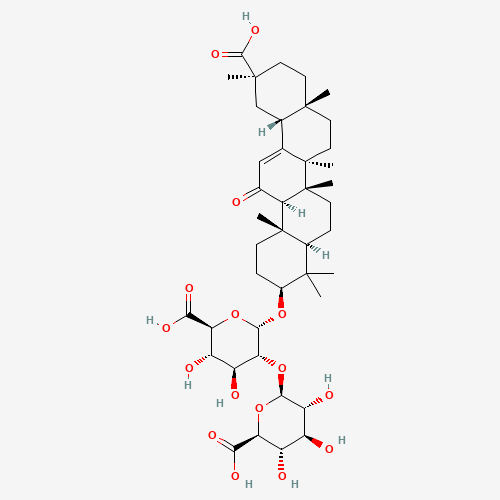
Glycyrrhizic Acid
AKA “glycyrrhizin, Glycyrrhizinic acid, 1405-86-3, Glycyron, potenlini, beta-Glycyrrhizin, Glycyrrhetinic acid glycoside, Glizigen, 18beta-Glycyrrhizic acid”
Acid
Ingredient Facts
Glycyrrhizic acid
AKA: Glycyrrhizin, Glycyrrhizinic acid, 1405-86-3, Glycyron, Potenlini, Beta-Glycyrrhizin, Glycyrrhetinic acid glycoside, Glizigen, 18beta-Glycyrrhizic acid
Acid · Humectant · EWG: 4
Synthetic
Humectant
Skin Conditioner
Acid
Not Clean
Glycyrrhizic acid is extracted from the root of the licorice plant; Glycyrrhiza glabra. It is a triterpene glycoside with glycyrrhetinic acid that possesses a wide range of pharmacological and biological activities. When extracted from the plant, it can be obtained in the form of ammonium glycyrrhizin and mono-ammonium glycyrrhizin. Glycyrrhizic acid has been developed in Japan and China as a hepatoprotective drug in cases of chronic hepatitis. From January 2014, glycyrrhizic acid as part of the licorice extract was approved by the FDA as an existing food sweetener. It was approved by Health Canada to be used in over-the-counter products but all the products are currently on the status canceled post marketed.
Solubility Easily soluble in hot water
Formula
C42H62O16
Mol. Weight
822.90
CAS #
1405-86-3
Form
Liquid
State
Solid with intensely sweet taste; [Merck Index] Crystalline plates or prisms; [MSDSonline]
See origin →
Functions
Humectant
A moisture magnet. Pulls water from the air and deeper skin layers up to the surface to keep skin plump and hydrated.
Skin Conditioning
A catch-all term for ingredients that improve how skin looks and feels — softer, smoother, more supple. The workhorse behind most moisturizers.
Locks In Moisture
Traditional Use
The primary active saponin compound in licorice root, chemically isolated in the early 20th century. Studied extensively from the 1970s onward for anti-inflammatory and skin-conditioning effects in modern skincare.
Skin Types
●all-skin-types
Best For
Redness
Pregnancy & Breastfeeding Safe
Caution
Final Report on the Safety Assessment of Glycyrrhetinic Acid, Potassium Glycyrrhetinate, Disodium Succinoyl Glycyrrhetinate, Glyceryl Glycyrrhetinate, Stearyl Glycyrrhetinate, Glycyrrhizic Acid, Ammon
Cosmetic Ingredient Review (CIR) Expert Panel
International Journal of Toxicology
Glycyrrhizic Acid
European Commission
EU Cosmetic Ingredient Database (CosIng)
Potassium Glycyrrhizinate
European Commission
EU Cosmetic Ingredient Database (CosIng)
Glycyrrhizin and Mannitol Nasal Therapy: Cytological and ...
Giulio Pagliuca, Veronica Clemenzi, Salvatore Martellucci, Francesco Gazia, Sara Santarsiero, Luigi Farina + 2 more
International archives of otorhinolaryngology, 2023
Bioactive Glycyrrhizic Acid Ionic Liquid Self-Assembled Nanomicelles for Enhanced Transdermal Delivery of Anti-Photoaging Signal Peptides.
Wang Z, Liu J, Chen Q, Wu Y, Li Y et al.
Advanced science (Weinheim, Baden-Wurttemberg, Germany), 2025
Bioactive Glycyrrhizic Acid Ionic Liquid Self-Assembled Nanomicelles for Enhanced Transdermal Delivery of Anti-Photoaging Signal Peptides.
Wang Z, Liu J, Chen Q, Wu Y, Li Y et al.
Advanced science (Weinheim, Baden-Wurttemberg, Germany), 2025
Verified Jun 2026
Data: PubChem · CosIng · EWG · CIR