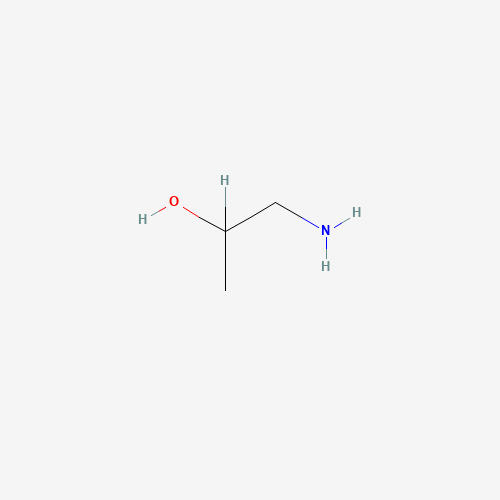
Isopropanolamine
AKA “1-Aminopropan-2-ol, 1-AMINO-2-PROPANOL, Threamine, Monoisopropanolamine, DL-1-Amino-2-propanol, 2-Hydroxypropylamine, 2-Propanol, 1-amino-, 1-Methyl-2-aminoethanol, 2-Amino-1-methylethanol”
Ingredient
Ingredient Facts
Isopropanolamine
AKA: 1-Aminopropan-2-ol, 1-AMINO-2-PROPANOL, Threamine, Monoisopropanolamine, DL-1-Amino-2-propanol, 2-Hydroxypropylamine, 2-Propanol, 1-amino-, 1-Methyl-2-aminoethanol, 2-Amino-1-methylethanol
Ingredient · Buffering · EWG: 4
Synthetic
Not Clean
Monoisopropanolamine appears as a colorless liquid with a slight ammonia-like odor. Less dense than water and soluble in water. Flash point 165 °F. Corrosive to metals and tissue. Vapors are heavier than air. Produces toxic oxides of nitrogen during combustion. Used in plastics, paints, cutting oils, and specialized cleaning compounds.
Solubility greater than or equal to 100 mg/mL at 67.6 °F (NTP, 1992)
Formula
C3H9NO
Mol. Weight
75.11
CAS #
78-96-6
Form
Liquid
State
Monoisopropanolamine appears as a colorless liquid with a slight ammonia-like odor. Less dense than water and soluble in water. Flash point 165 °F. Corrosive to metals and tissue. Vapors are heavier t
See origin →
Functions
Buffering
Stabilizes pH
Traditional Use
A synthetic organic compound developed in the 20th century for use as a neutralizing agent and emulsifier in cosmetics. Used to adjust pH and improve product stability in creams and lotions.
Skin Types
●all-skin-types
Best For
General
Pregnancy & Breastfeeding Safe
Caution
Extended Re-review Summary: Safety Assessment of Diisopropanolamine, Triisopropanolamine, Isopropanolamine, and Mixed Isopropanolamines
Cosmetic Ingredient Review (CIR) Expert Panel
International Journal of Toxicology
Final Report on the Safety Assessment of Diisopropanolamine, Triisopropanolamine, Isopropanolamine, and Mixed Isopropanolamine
Cosmetic Ingredient Review (CIR) Expert Panel
International Journal of Toxicology
Isopropanolamine
European Commission
EU Cosmetic Ingredient Database (CosIng)
Triisopropanolamine
European Commission
EU Cosmetic Ingredient Database (CosIng)
2-Methyl-1-Phenyl-2-Propanol
Environmental Working Group (EWG)
EWG Skin Deep Cosmetics Database
Diisopropanolamine
Environmental Working Group (EWG)
EWG Skin Deep Cosmetics Database
Isopropanolamine
Environmental Working Group (EWG)
EWG Skin Deep Cosmetics Database
Mixed Isopropanolamine
Environmental Working Group (EWG)
EWG Skin Deep Cosmetics Database
Mixed Isopropanolamines
Environmental Working Group (EWG)
EWG Skin Deep Cosmetics Database
Triisopropanolamine
Environmental Working Group (EWG)
EWG Skin Deep Cosmetics Database
β-elemene Isopropanolamine Derivative LXX-8250 Induces Apoptosis Through Impairing Autophagic Flux via PFKFB4 Repression in Melanoma Cells.
Jalal S, Zhang T, Deng J, Wang J, Xu T et al.
Frontiers in pharmacology, 2022
Pharmacokinetics and bioavailability of diisopropanolamine (DIPA) in rats following intravenous or dermal application.
Saghir SA, Frantz SW, Spence MW, Nolan RJ, Lowe ER et al.
Food and chemical toxicology : an international journal published for the British Industrial Biological Research Association, 2007
Verified Jun 2026
Data: PubChem · CosIng · EWG · CIR