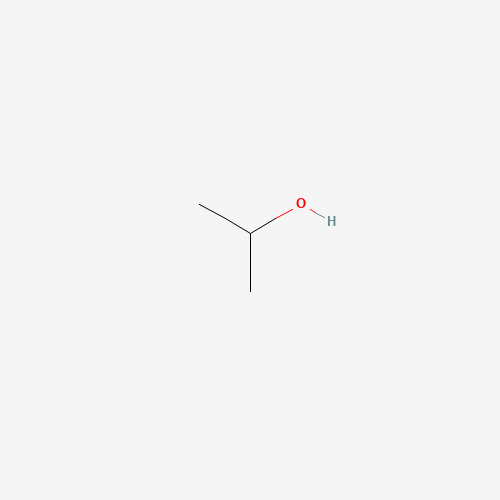





Isopropyl Alcohol
AKA “isopropanol, 2-Propanol, Propan-2-ol, 67-63-0, 2-Hydroxypropane, Dimethylcarbinol, sec-Propyl alcohol, Alkolave, Avantine”
Ingredient
Ingredient Facts
Isopropyl alcohol
AKA: Isopropanol, 2-Propanol, Propan-2-ol, 67-63-0, 2-Hydroxypropane, Dimethylcarbinol, Sec-Propyl alcohol, Alkolave, Avantine
Ingredient · Antifoaming · EWG: 2
Synthetic
Fragrance
Solvent
Clean
Volatile, colorless liquid with a sharp musty odor like rubbing alcohol. Flash point of 53 °F. Vapors are heavier than air and mildly irritating to the eyes, nose, and throat. Density approximately 6.5 lb / gal. Used in making cosmetics, skin and hair preparations, pharmaceuticals, perfumes, lacquer formulations, dye solutions, antifreezes, soaps, window cleaners. Sold in 70% aqueous solution as rubbing alcohol.
Solubility greater than or equal to 100 mg/mL at 72 °F (NTP, 1992)
Formula
C3H8O
Mol. Weight
60.10
CAS #
67-63-0
Form
Liquid
State
Volatile, colorless liquid with a sharp musty odor like rubbing alcohol. Flash point of 53 °F. Vapors are heavier than air and mildly irritating to the eyes, nose, and throat. Density approximately 6.
See origin →
Functions
Antifoaming
Perfuming
Added for scent. Can be natural or synthetic. Common irritant and allergen — one of the top reasons people react to products.
Solvent
Dissolves other ingredients so they distribute evenly in the formula. Often the invisible "base" everything else is mixed into.
Viscosity Controlling
Prevents Foam Buildup
Adds Fragrance
Dissolves Ingredients
Controls Viscosity
Antioxidant Protection
Reduces Inflammation
Locks In Moisture
Adds pleasant scent
Reduces foam
Dissolves other ingredients
Controls product thickness
Traditional Use
Synthesized from petroleum or fermentation in the early 20th century, isopropyl alcohol became widely used in cosmetics as an antimicrobial and drying agent starting in the 1920s-1930s.
Skin Types
●all-skin-types
Best For
General
Pregnancy & Breastfeeding Safe
Caution
Extended Re-review Summary: Safety Assessment of Diisopropanolamine, Triisopropanolamine, Isopropanolamine, and Mixed Isopropanolamines
Cosmetic Ingredient Review (CIR) Expert Panel
International Journal of Toxicology
Final Report on the Safety Assessment of Diisopropanolamine, Triisopropanolamine, Isopropanolamine, and Mixed Isopropanolamine
Cosmetic Ingredient Review (CIR) Expert Panel
International Journal of Toxicology
Final Report on the Safety Assessment of Methoxyisopropanol and Methoxyisopropyl Acetate as Used in Cosmetics
Cosmetic Ingredient Review (CIR) Expert Panel
International Journal of Toxicology
Isopropanolamine
European Commission
EU Cosmetic Ingredient Database (CosIng)
Isopropyl Alcohol
European Commission
EU Cosmetic Ingredient Database (CosIng)
Methoxyisopropanol
European Commission
EU Cosmetic Ingredient Database (CosIng)
Triisopropanolamine
European Commission
EU Cosmetic Ingredient Database (CosIng)
Final report on the safety assessment of methoxyisopropanol and methoxyisopropyl acetate as used in cosmetics.
Cosmetic Ingredient Review Expert Panel
International journal of toxicology, 2008
2-Methyl-1-Phenyl-2-Propanol
Environmental Working Group (EWG)
EWG Skin Deep Cosmetics Database
Diisopropanolamine
Environmental Working Group (EWG)
EWG Skin Deep Cosmetics Database
Isopropanolamine
Environmental Working Group (EWG)
EWG Skin Deep Cosmetics Database
Isopropyl Alcohol
Environmental Working Group (EWG)
EWG Skin Deep Cosmetics Database
Mixed Isopropanolamine
Environmental Working Group (EWG)
EWG Skin Deep Cosmetics Database
Mixed Isopropanolamines
Environmental Working Group (EWG)
EWG Skin Deep Cosmetics Database
Triisopropanolamine
Environmental Working Group (EWG)
EWG Skin Deep Cosmetics Database
Methoxyisopropanol
Health Canada
Health Canada Cosmetic Ingredient Hotlist
β-elemene Isopropanolamine Derivative LXX-8250 Induces Apoptosis Through Impairing Autophagic Flux via PFKFB4 Repression in Melanoma Cells.
Jalal S, Zhang T, Deng J, Wang J, Xu T et al.
Frontiers in pharmacology, 2022
Antimicrobial activity of Butyl acetate, Ethyl acetate and Isopropyl alcohol on undesirable microorganisms in cosmetic products.
Lens C, Malet G, Cupferman S
International journal of cosmetic science, 2016
Pharmacokinetics and bioavailability of diisopropanolamine (DIPA) in rats following intravenous or dermal application.
Saghir SA, Frantz SW, Spence MW, Nolan RJ, Lowe ER et al.
Food and chemical toxicology : an international journal published for the British Industrial Biological Research Association, 2007
Verified Jun 2026
Data: PubChem · CosIng · EWG · CIR