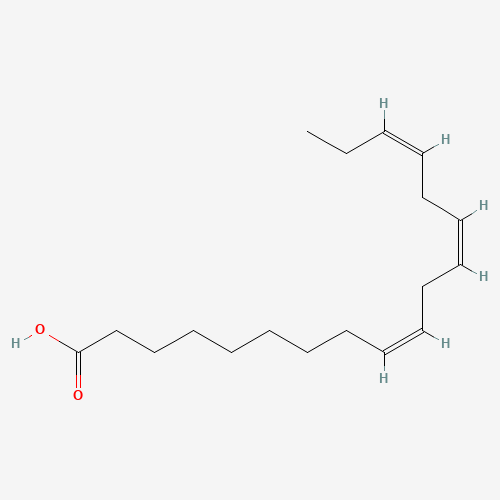
Linolenic Acid
AKA “alpha-Linolenic acid, 463-40-1, (9Z, 12Z, 15Z)-octadeca-9, 12, 15-trienoic acid, all-cis-9, 15-Octadecatrienoic acid, (Z, Z, Z)-9, cis, cis-9, alpha Linolenic Acid, 9-cis, 12-cis, 15-cis-Octadecatrienoic acid, 9, Z)-”
Fatty Acid
Ingredient Facts
Linolenic acid
AKA: Alpha-Linolenic acid, 463-40-1, (9Z, 12Z, 15Z)-octadeca-9, 12, 15-trienoic acid, All-cis-9, 15-Octadecatrienoic acid, (Z, Z, Z)-9, Cis, Cis-9, Alpha Linolenic Acid, 9-cis, 12-cis, 15-cis-Octadecatrienoic acid, 9, Z)-
Fatty Acid · Buffering · EWG: 2
Synthetic
Skin Conditioner
Fatty Acid
Clean
Alpha-linolenic acid is a linolenic acid with cis-double bonds at positions 9, 12 and 15. Shown to have an antithrombotic effect. It has a role as a micronutrient, a nutraceutical and a mouse metabolite. It is a linolenic acid and an omega-3 fatty acid. It is a conjugate acid of an alpha-linolenate and a (9Z,12Z,15Z)-octadeca-9,12,15-trienoate.
Solubility less than 1 mg/mL at 72 °F (NTP, 1992)
Formula
C18H30O2
Mol. Weight
278.40
CAS #
463-40-1
Form
Liquid
State
Linolenic acid is a clear colorless liquid. (NTP, 1992)
See origin →
Functions
Skin Conditioning
A catch-all term for ingredients that improve how skin looks and feels — softer, smoother, more supple. The workhorse behind most moisturizers.
Buffering
Reduces Static
Removes Impurities
Conditions Hair
Adds Fragrance
Traditional Use
An essential omega-3 fatty acid identified in the early 20th century. Historically valued in traditional diets from flaxseed and other plant sources; modern skincare adopted it for its role in maintaining skin barrier function and reducing inflammation.
Skin Types
●all-skin-types
Best For
Dryness
Pregnancy & Breastfeeding Safe
Yes
Gamma-linolenic acid in borage oil reverses epidermal hyperproliferation in guinea pigs.
Chung S, Kong S, Seong K, Cho Y
The Journal of nutrition, 2002
Linolenic Acid
Environmental Working Group (EWG)
EWG Skin Deep Cosmetics Database
Serum levels of stearic and dihomo-γ-linolenic acids can be used to diagnose cervical cancer and cervical intraepithelial neoplasia.
Katoh Y, Kubo A, Hayashi N, Sugi T, Katoh K et al.
Scientific reports, 2024
Verified Jun 2026
Data: PubChem · CosIng · EWG · CIR