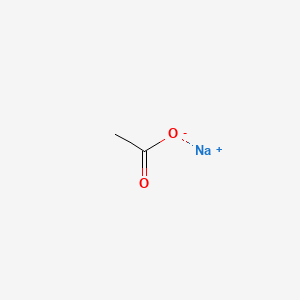
Sodium Acetate
AKA “127-09-3, Acetic acid, sodium salt, Sodium acetate anhydrous, Sodium acetate, anhydrous, Anhydrous sodium acetate, Sodii acetas, Sodium ethanoate, Natrium aceticum, FEMA No. 3024”
Ingredient
Ingredient Facts
Sodium acetate
AKA: 127-09-3, Acetic acid, Sodium salt, Sodium acetate anhydrous, Anhydrous, Anhydrous sodium acetate, Sodii acetas, Sodium ethanoate, Natrium aceticum, FEMA No. 3024
Ingredient · Buffering · EWG: 1
Synthetic
Clean
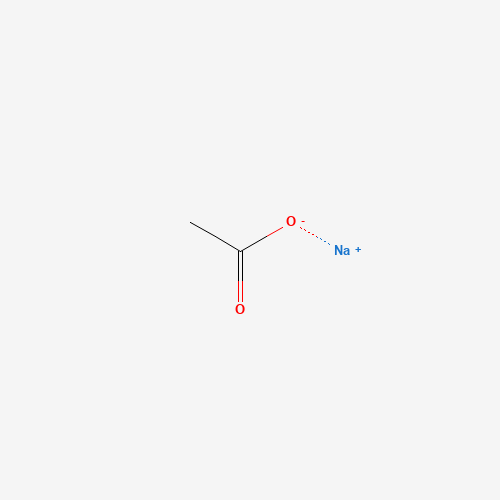
Sodium Acetate Anhydrous is the anhydrous, sodium salt form of acetic acid. Sodium acetate anhydrous disassociates in water to form sodium ions (Na+) and acetate ions. Sodium is the principal cation of the extracellular fluid and plays a large part in fluid and electrolyte replacement therapies. Sodium acetate anhydrous is used as an electrolyte replenisher in isosmotic solution for parenteral replacement of acute losses of extracellular fluid without disturbing normal electrolyte balance.
Solubility WATER: 119 G/100 ML @ 0 °C, 170.15 G/100 ML @ 100 °C; SLIGHTLY SOL IN ALCOHOL
Formula
C2H3NaO2
Mol. Weight
82.03
CAS #
127-09-3
Form
Powder
State
Dry Powder; Liquid; Pellets or Large Crystals
See origin →
Functions
Buffering
Anti-Inflammatory
Boosts Collagen
Wound Healing
Provides scent
Maintains optimal pH
Traditional Use
Developed as a chemical buffer and preservative in the 20th century; while acetic acid (vinegar) has ancient cosmetic use in cleansing and skin toning, sodium acetate itself is a modern synthetic derivative without traditional roots.
Skin Types
●all-skin-types
Best For
General
Pregnancy & Breastfeeding Safe
Yes
Effects of Sodium Salts of Fatty Acids and Their Derivatives on Skin Permeation of Cromolyn Sodium.
Akinbote OE, Verana G, Dandekar AA, Tijani AO, Mishra D et al.
AAPS PharmSciTech, 2023
Effects of Sodium Salts of Fatty Acids and Their Derivatives on Skin Permeation of Cromolyn Sodium.
Akinbote OE, Verana G, Dandekar AA, Tijani AO, Mishra D et al.
AAPS PharmSciTech, 2023
Safety Assessment of Tetrasodium Glutamate Diacetate and Beta-Alanine Diacetic Acid as Used in Cosmetics.
Burnett CL, Bergfeld WF, Belsito DV, Cohen DE, Klaassen CD et al.
International journal of toxicology, 2025
Safety Assessment of Tetrasodium Glutamate Diacetate and Beta-Alanine Diacetic Acid as Used in Cosmetics.
Burnett CL, Bergfeld WF, Belsito DV, Cohen DE, Klaassen CD et al.
International journal of toxicology, 2025
Sodium Dehydroacetate and Dehydroacetic Acid.
Cherian P, Bergfeld WF, Belsito DV, Cohen DE, Klaassen CD et al.
International journal of toxicology, 2024
Sodium Dehydroacetate and Dehydroacetic Acid.
Cherian P, Bergfeld WF, Belsito DV, Cohen DE, Klaassen CD et al.
International journal of toxicology, 2024
Final Report on the Safety Assessment of Sodium Dehydroacetate and Dehydroacetic Acid
Cosmetic Ingredient Review (CIR) Expert Panel
International Journal of Toxicology
Safety Assessment of Tetrasodium Glutamate Diacetate and Beta-Alanine Diacetic Acid as Used in Cosmetics
Cosmetic Ingredient Review (CIR) Expert Panel
International Journal of Toxicology
Sodium Dehydroacetate and Dehydroacetic Acid
Cosmetic Ingredient Review (CIR) Expert Panel
International Journal of Toxicology
Acetic Acid
European Commission
EU Cosmetic Ingredient Database (CosIng)
Beta-Alanine Diacetic Acid
European Commission
EU Cosmetic Ingredient Database (CosIng)
dehydroacetic acid
European Commission
EU Cosmetic Ingredient Database (CosIng)
Sodium Acetate
European Commission
EU Cosmetic Ingredient Database (CosIng)
Acetic acid and the skin: a review of vinegar in dermatology.
Elhage KG, St Claire K, Daveluy S
International journal of dermatology, 2022
Acetic acid and the skin: a review of vinegar in dermatology.
Elhage KG, St Claire K, Daveluy S
International journal of dermatology, 2022
Acetic Acid
Environmental Working Group (EWG)
EWG Skin Deep Cosmetics Database
dehydroacetic acid
Environmental Working Group (EWG)
EWG Skin Deep Cosmetics Database
Sodium Acetate
Environmental Working Group (EWG)
EWG Skin Deep Cosmetics Database
SODIUM SALT
Environmental Working Group (EWG)
EWG Skin Deep Cosmetics Database
Potential application of novel liquid crystal nanoparticles of isostearyl glyceryl ether for transdermal delivery of 4-biphenyl acetic acid.
Fujii MY, Asakawa Y, Fukami T
International journal of pharmaceutics, 2020
Preparation of (13)C-labeled ceramide by acetic acid bacteria and its incorporation in mice.
Fukami H, Tachimoto H, Kishi M, Kaga T, Waki H et al.
Journal of lipid research, 2010
Trichloroacetic acid
Health Canada
Health Canada Cosmetic Ingredient Hotlist
Sodium acetate ameliorates cisplatin-induced kidney injury in vitro and in vivo.
Zheng JY, Wang SC, Tang SC, Hsin IL, Kang YT et al.
Chemico-biological interactions, 2023
Verified Jun 2026
Data: PubChem · CosIng · EWG · CIR