Sodium Hydroxide
AKA “1310-73-2, Caustic soda, Sodium hydrate, Aetznatron, Soda lye, White caustic, Soda, caustic, Natriumhydroxid, Rohrputz”
Synthetic
Ingredient Facts
Sodium hydroxide
AKA: 1310-73-2, Caustic soda, Sodium hydrate, Aetznatron, Soda lye, White caustic, Soda, Caustic, Natriumhydroxid, Rohrputz
Synthetic · Buffering · EWG: 4
Synthetic
Synthetic
Not Clean
Sodium hydroxide is also known as lye or soda , or caustic soda. At room temperature, sodium hydroxide is a white crystalline odorless solid that absorbs moisture from the air. It is a synthetically manufactured substance. When dissolved in water or neutralized with acid it releases substantial amounts of heat, which may prove sufficient to ignite combustible materials. Sodium hydroxide is highly corrosive. Sodium hydroxide is generally used as a solid or a diluted in a 50% solution. This chemical is used to manufacture soaps, rayon, paper, explosives, dyestuffs, and petroleum products. It is also used in processing cotton fabric, laundering and bleaching, metal cleaning and processing, oxide coating, electroplating, and electrolytic extracting. It is commonly found in commercial drain/ oven cleaners. According to the the FDA, sodium hydroxide is considered a direct food recognized as safe, where it serves as a pH control agent and follows good manufacturing guidelines. Interesting
Solubility 111 % (NIOSH, 2024)
Formula
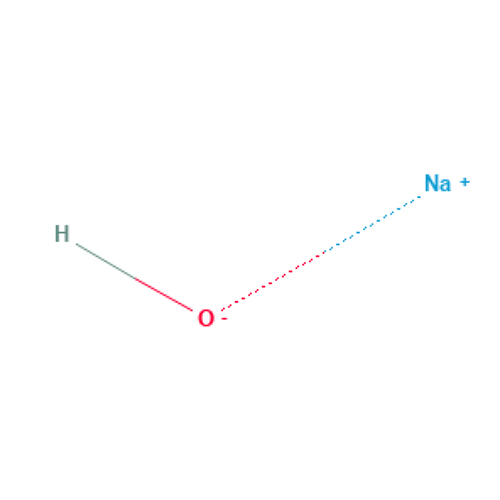
HNaO
Mol. Weight
40.00
CAS #
1310-73-2
Form
Powder
State
Sodium hydroxide solution appears as a colorless liquid. More dense than water. Contact may severely irritate skin, eyes, and mucous membranes. Toxic by ingestion. Corrosive to metals and tissue.
See origin →
Functions
Buffering
Denaturant
Stabilizes pH
Makes Alcohol Undrinkable
Traditional Use
This ingredient name is incomplete and cannot be identified without further specification. PELLETS is a physical form descriptor rather than a specific ingredient with historical use.
Skin Types
●all-skin-types
Take the Skin ID quiz to see if this matches your skinEWG
4
CIR
Insufficient
Pregnancy
—
CIR Safety Findings
Not a Sensitizer
all-shades-safe
Concentration Guide
5.0%
0%7%
Reg. Limit
EU regulatory limit: 5.0%. (a) 5% (5) (b) 1. 2% (5) 2. 4.5% (5). (a) Contains alkali Avoid contact with eyes Can cause blindness Keep out of reach of children (b) 1. Contains alkali Avoid contact with eyes Can cause blindness Keep out of reach of children 2. F... Source: EU Cosmetics Regulation (EC) 1223/2009, Annex III (Restricted Substances), Entry 15a.
Regulatory Agencies
Pore Perfecting Liquid
Alpyn Beauty
Super Sculpt Serum
Alpyn Beauty
Slip Tint™ Undetectable Baked Setting Powder
Saie
CitySet™ Lightweight Setting Spray 95ml
Saie
Mini CitySet™ Lightweight Setting Spray
Saie
calming magnesium mist
Cocokind
calm & clarify duo
Cocokind
travel-size calming magnesium mist
Cocokind
Pacific Polish Gentle Sea Salt Facial Exfoliator
COOLA
Refreshing Water Cream
COOLA
Day SPF 30 & Night Eye Cream
COOLA
Face Sunscreen Lotion - White Tea
COOLA
Face Sunscreen Lotion - Fragrance Free
COOLA
Hydrating Sunscreen Lotion - Fragrance Free
COOLA
Hydrating Sunscreen Lotion - Guava Mango
COOLA
Hydrating Sunscreen Lotion - Peach Blossom
COOLA
3 Piece Classic Suncare Travel Set
COOLA
Dew Good Illuminating Body Melt Lotion
COOLA
Suncare Travel Essentials Set
COOLA
Clean-ical Formulations AM + PM Serum Duo
Odacité
Derm-Restore Super Serum • Edelweiss Extrême® • Peptides + Carnosine
Odacité
Edelweiss Extrême® • Repair + Restore Set
Odacité
Sun Defense Performance Duo • SPF 50 + Super Serum
Odacité
Anti-aging Dream Duo • SPF 50 + Retinol
Odacité
Bioactive Renew Supreme Cream • Edelweiss Extrême® • Peptides + Carnosine
Odacité
Edelweiss Extrême® Skin Barrier Set
Odacité
Day & Night Eye Care Duo
Odacité
Sun Damage Defense Duo • SPF 50 + Vitamin C
Odacité
Anti Aging Eye & Sun Defense Duo
Odacité
SPF 50 Color Balm Duo
Odacité
SPF 50 Tinted Sunscreen & Color Balm Duo
Odacité
Winter Renewal Ritual
Odacité
holi (lash) growth mascara
Agent Nateur
the lash growth duo
Agent Nateur
Hands to Heart
Goldfaden MD
Wake Up Call
Goldfaden MD
Ready, Set, Smooth
Goldfaden MD
The Ultimate Hydration Duo
Goldfaden MD
Dream Set
Goldfaden MD
Salicylic Acid 2% Clarifying Booster
Pai Skincare
Take Your Vitamins Duo
Indie Lee
Gentle Daily Peel
Indie Lee
AHA Exfoliating Solution
Indie Lee
Serum For Days! Trio
Indie Lee
Sunlit Essentials Set
Indie Lee
[Travel Size] Hydra-Restore Cream Cleanser (20mL)
Grown Alchemist
Regenerating Face Moisturizer (60ml)
Grown Alchemist
Skin Renewal Mask (75mL)
Grown Alchemist
Daily Acid Toner
Josh Rosebrook
Tulip Tint Lip & Cheek Balm
Bloom Effects
Verified Jun 2026
Data: PubChem · CosIng · EWG · CIR